Safety & the Rule

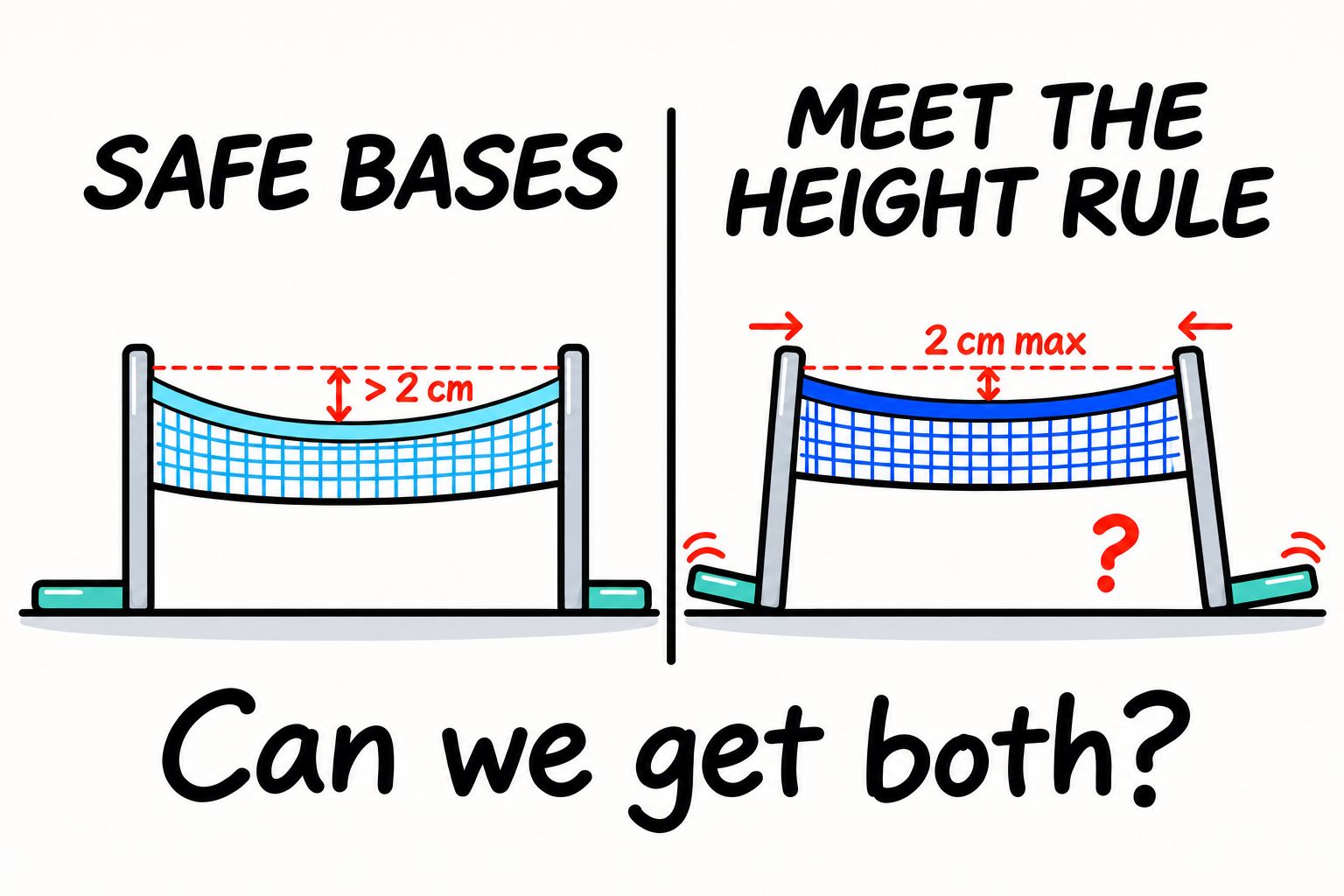
Safe bases and meeting the height rule: two volleyball nets illustrate the possible tension between a low-sag net and portable-base stability. Can we get both?
A concern to test, not an observed failure. The 2 cm tolerance compares the net at the sidelines with its official height at center.

Can you get both?

Court 1 / 30 points
Balance net height and portable-base stabilityA front view of a net between two posts. Tightening reduces sag, but too much pull makes both bases tip inward. Add ballast or widen the footprint to resist tipping. 2 cm rule Pull on the bases Front view · movement exaggerated
Stability in this model

A simplified physics game, not equipment setup guidance. The 2 cm rule

The problems to resolve

Safe setup.
A fair game.

Clear guidance for crews. Consistent conditions for players.

01 / SAFETY & THE HEIGHT RULE

When meeting the height rule may put stability at risk.

Tightening the top cable brings up a low center, but increases the pull on the posts. A portable base has a limit to how much pull it can resist before tipping.

The 2 cm height rule

USA Volleyball requires equal net heights over the two sidelines, no more than 2 cm above the official height measured at center.

Read Rule 2.1.2

Calculations using the field measurements suggest that, on some setups, reaching this tolerance could require enough cable pull to risk tipping a portable base. This is a model-based concern that needs direct testing; it is not evidence that a measured base tipped or was unsafe.

The practical question: what should crews do when meeting the height rule appears to require exceeding the equipment's safe setup limits? Clear, equipment-specific guidance would help them address both requirements.
02 / COURT-TO-COURT INCONSISTENCY

Same game. A different net on every court?

A serve clips the tape. A hit catches the net. In a close game, a few points can change the outcome. Differences in how the net responds deserve attention.

Measurements at four tournaments confirmed that the nets varied quite a bit in stiffness: how much force it takes to move them by a given distance.

Measured stiffness146 to 354 N/m

About 2.4-fold variation across the 48 courts.

The practical question: how much does this variation change a ball's response, and could a simple check make courts more consistent? Controlled ball tests and counts of net contacts in games are the next steps.

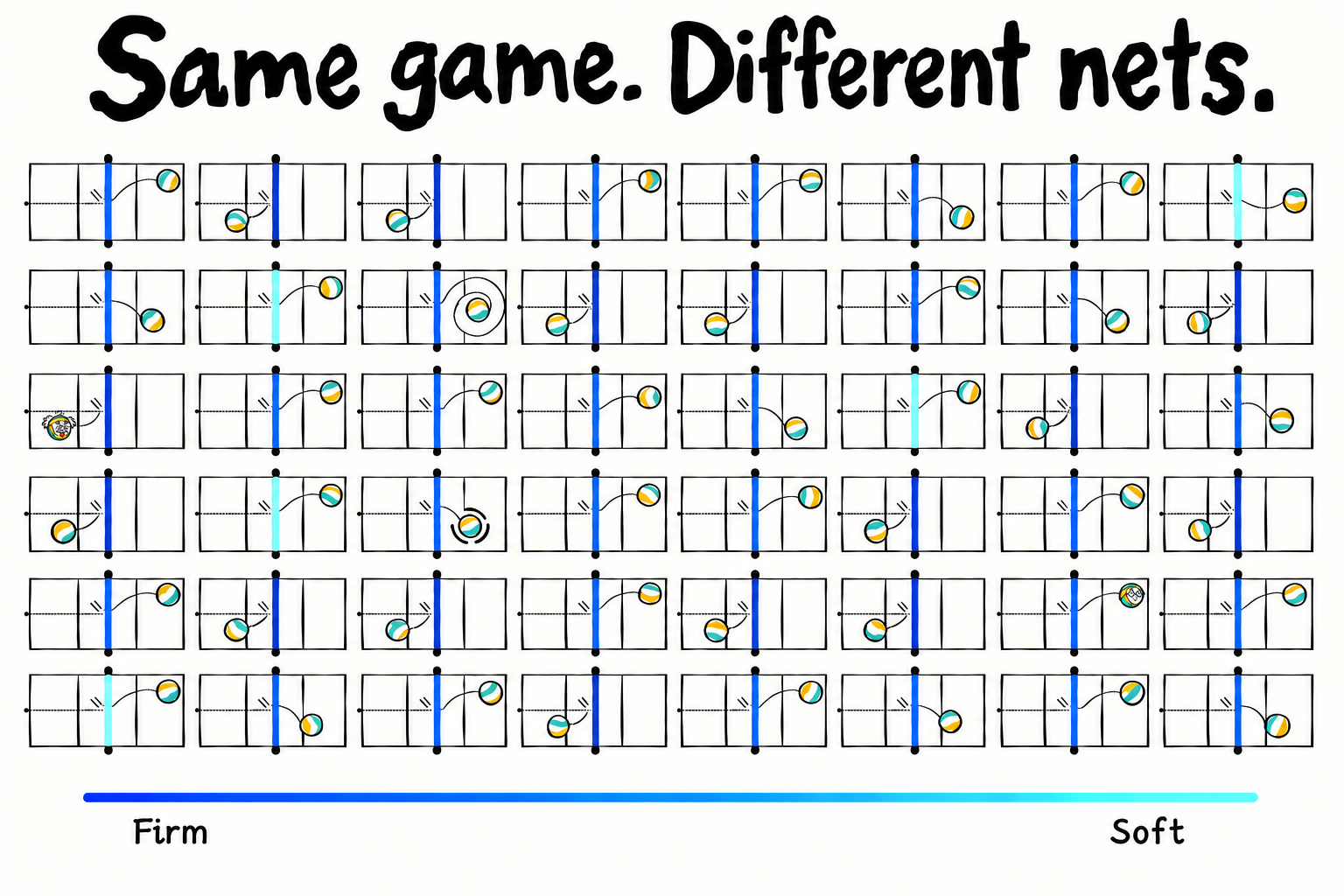
Same game. Different nets. A cartoon of 48 uniform volleyball courts, with blue nets shaded from firm to soft and colorful volleyballs following different paths after touching the net.
A cartoon about why court-to-court consistency matters.View larger
What is measured, and what still needs testing?

Measured in the field

48 courts at four tournaments, using a 1.105 kg load near midspan. Stiffness ranged from 146 to 354 N/m. The sideline-to-center height difference exceeded 2 cm on 45 courts. Courts were measured after play and were not a random sample.

Questions to validate

Cable tension and tipping risk were inferred from simplified models. Direct cable tension, support stability, and ball response were not tested. Mesh, bands, bottom cords, and post flexibility can affect the measurement. The paper's 250 lb value is a comparison reference; operating limits depend on the specific system.

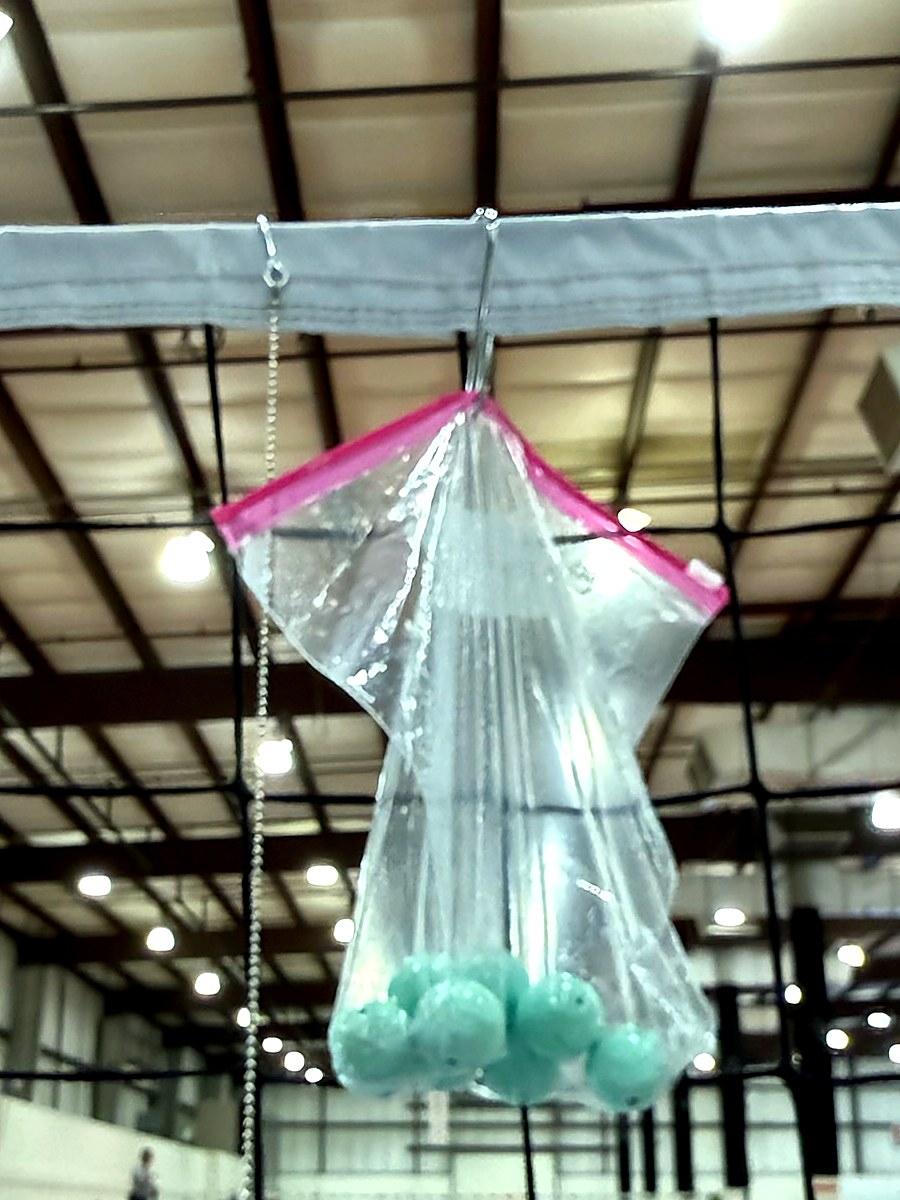
A bag of known weight hanging from the top band of a volleyball net, beside the bead chain used to measure net height.
A known weight and a displacement measurement: the field method used to compare nets.

Why I'm asking

A concern from
the court.

I'm Allison Hua, a high school volleyball player. Some tournament nets felt much softer and less consistent than the ones we used at school and club practice.

I made a simple tool and measured nets at four tournaments I played in. The differences led me to look at cable tension and portable-base stability too.

I want to understand what would help our volleyball community make the game safer and fairer. The measurements and paper below are a starting point for that conversation.

Start a conversation

What would help
resolve these concerns?

Setup experience, existing guidance, or a useful correction would help. Choose the question closest to your work; even one piece of advice can move the conversation forward.

TOURNAMENT ORGANIZERSHow do your crews check the courts?

I'd like to learn how you check net height, tension, and support setup across courts, and how often you recheck during an event. Could a small, supervised measurement study fit into that process?

Share setup experience
RESEARCHERS & ENGINEERSHelp me test the model.

Which measurement would best check the relationship between net stiffness and cable tension? I'm particularly interested in separating the cable's contribution from the mesh, bands, and supports.

Offer technical feedback
RULES OFFICIALSWhere can crews find guidance?

What should crews do if a correctly assembled system remains outside the 2 cm height tolerance at the manufacturer's approved tension? I'm looking for official guidance and the right way to investigate this concern.

Point me to guidance
EQUIPMENT COMPANIESWhat does your system need?

I'd appreciate model-specific setup instructions, recommended tension ranges, and advice on what crews should check before tightening further. Understanding ballast, mesh adjustments, and support geometry would help me improve the model.

Share equipment guidance
VIDEO & AI TEAMSHow often does a ball touch the net?

I'd like to count net contacts in tournament games. Match footage, existing contact counts, or advice on video analysis would help. A few matches could test the counting method before expanding to a larger sample.

Talk about footage or analysis

Supporting evidence

Where the concerns
come from.

The overview and manuscript explain the measurements, the model, and what still needs checking.

The proposed checks and model predictions need validation. Equipment adjustments should follow the manufacturer's instructions.

What needs checking next

From a concern
to useful guidance.

Direct force-and-displacement measurements can help check the model against a real net and its supports. Controlled ball tests and match-video counts can show how net stiffness affects play and how often those differences might matter.

The goal is practical: clear setup guidance and safer, more consistent courts.

Updated November 17, 2026